

Rabbit vs Classic Vibrators: Fit, Controls and What to Check
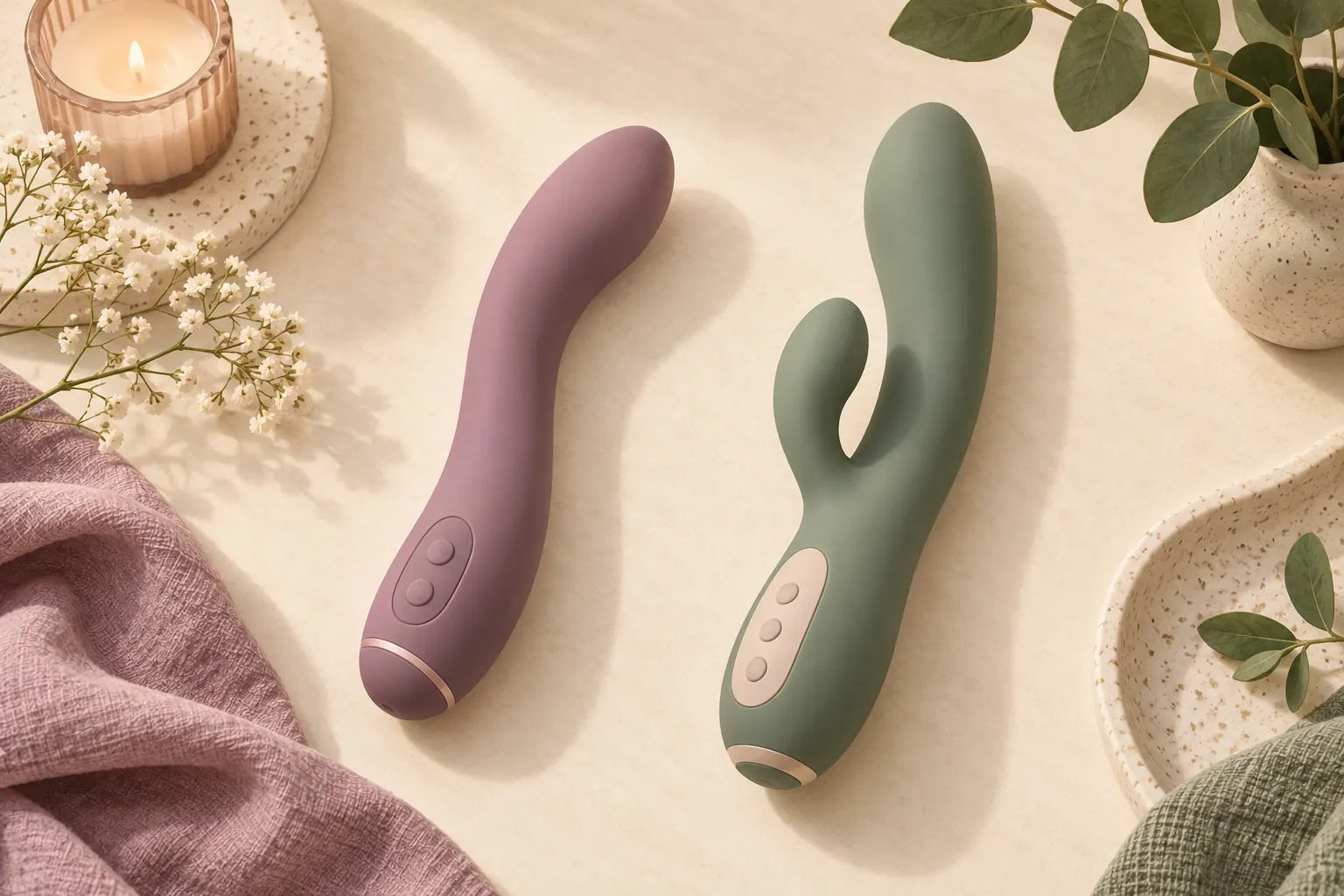
The main difference is positioning: a rabbit vibrator combines an insertable section with an external arm, while a classic design has one main body without that extra branch. A rabbit asks you to consider how two contact areas line up together. A classic shape removes that particular alignment question, but its curve, width, grip and controls still need to suit your priorities.
Neither format is automatically better, stronger or more suitable for a first purchase. Start with the shape you want, then compare the measurements and operating instructions. If you are still weighing up bullets, wands and other styles, begin with our first-vibrator buying guide. This comparison focuses on the extra decisions involved in choosing between a rabbit and a single-body design.
Rabbit or classic: the practical differences
| Detail | Rabbit design | Classic design |
|---|---|---|
| Contact layout | Check the insertable section and the external arm together. | Check the main body's curve, tip and intended contact areas. |
| Positioning | Consider whether changing depth or angle also changes where the external arm sits. | Consider how the body can be held and angled without a second branch. |
| Measurements | Look for insertable length, width and any documented arm spacing or adjustment. | Look for insertable length, width, curve and usable grip. |
| Controls | Verify whether settings are shared or separately adjustable; do not infer this from two contact areas. | Check intensity adjustment, pattern selection and how to stop or lower the setting. |
| Everyday use | Check access to buttons and cleaning around the join between the two sections. | Check access to buttons, charging connection and any joins or removable parts. |
Why alignment matters more than the category name
A rabbit's external arm is part of the same device as its insertable section. When you compare designs, consider both contact points rather than choosing by total length alone. Ask what happens to the external arm's position when the main body is tilted, and whether the maker describes any flexibility or adjustment.
Do not assume every arm bends, or that a flexible-looking shape has an unlimited range of movement. Look for the manufacturer's description and a clear diagram. If the spacing you need is not supplied, ask about that exact model instead of estimating it from a product photograph. A familiar rabbit outline does not establish a particular fit.
A classic shape avoids the extra branch, which may appeal if you want a simpler shape to position. It can still be straight, tapered or curved, and the permitted uses vary. Follow the maker's stated purpose rather than assuming that a category label makes a device suitable for every kind of use.
Read measurements without confusing size and fit
Overall length and insertable length are different measurements. The handle, base and controls can take up part of a device's total length. Overall width on a rabbit may include its branching shape, so it should not automatically be read as the diameter of the insertable section.
For a documentary example, LELO's current INA 3 page and linked manual both list a 200 × 65 × 45 mm body and 110 mm insertable length. Its current LIV 3 page and linked manual list 169 × 35 × 42 mm and 100 mm respectively. Those figures describe the named models, not typical dimensions for every rabbit or classic vibrator, and they do not establish how either will fit you.
Our source check did not establish a numerical arm-spacing measurement for INA 3, and we have not measured either product ourselves. The listed dimensions therefore cannot settle arm spacing or predict fit. These models illustrate how to read documentation; they are not hands-on product recommendations.
Do two contact areas mean independent controls?
Not necessarily. Check the actual button sequence and the functions it changes. Two contact areas do not, by themselves, tell you whether you can adjust each area separately. A mode count is not a description of motor independence or a measurement of strength.
For example, INA 3's linked manual describes plus and minus intensity controls and separate pattern-selection buttons. It does not document independent intensity adjustment for each contact area in that operating sequence. LIV 3's manual describes three onboard buttons for intensity and mode selection, with optional app functions. These are model-specific instructions, not rules for their whole categories.
Before buying, find out whether you can lower intensity directly, return to a preferred pattern, stop promptly and use the functions you need without a phone. If separate adjustment is essential, look for an explicit statement covering it or ask the manufacturer. Our app-versus-remote guide explains the additional checks for connected controls.
Check grip and button placement as well as the contact end
Think about the part you will hold. A clear product photograph or manual diagram should show where the controls sit and how much space is available around them. Compare whether you would need to change your grip to reach a button, and whether the button labels or operating sequence are understandable.
A more elaborate shape is not automatically harder to manage, and fewer buttons do not guarantee simpler operation. One button can perform several actions through short presses or holding it down. Read the sequence before deciding what “easy to use” means for you. Do not use a mode count or a promotional intensity claim as a substitute for that practical check.
Power and care are separate decisions
Rabbit and classic describe shapes, not power systems or water ratings. Check the exact battery or charging requirements, included cable and water-exposure instructions on every shortlisted model. A waterproof device does not establish that its remote or charging equipment can get wet.
Read the care instructions for the full shape, including joins and any detachable parts. Do not force an arm or remove a section unless the maker says it is designed for that. Follow the exact model's lubricant guidance too, rather than assuming every formula suits every silicone surface.
Use our cleaning and care guide for the manual-first checklist and our lubricant compatibility guide to check the toy, formula and any condom together. If power source is deciding your shortlist, read rechargeable versus battery-powered vibrators.
A five-question shortlist
- Do you want a combined shape? Consider a rabbit if having the two contact sections in one device is a feature you specifically want, then investigate their alignment.
- Would you prefer one main body? Compare classic designs if you do not want an external branch, without assuming all classic shapes are identical.
- Are the useful measurements available? Compare insertable length, relevant width and grip; identify any missing arm-spacing or adjustment information.
- Do the controls match your priorities? Confirm the adjustment sequence, any genuinely separate functions and whether a phone is optional.
- Can you maintain the exact model as directed? Check charging accessories, cleaning, drying, storage and lubricant instructions before ordering.
Browse Rabbit Vibrators or Classic Vibrators with that checklist in mind. The collection name narrows the starting point; the individual model's shape and instructions should decide the shortlist. For the wider choice of styles, return to the vibrator range.
Sources and editorial note
Manufacturer documents checked 16 October 2026: LELO INA 3 product information and its linked INA 3 manual; LELO LIV 3 product information and its linked LIV 3 manual. This guide uses only the relevant supported fields; it does not compare disputed battery, warranty or automatic-shutoff details.
Randy Fox editorial guide, prepared with AI assistance for research organisation, drafting and the decorative illustration. No hands-on testing or measured fit assessment was performed. The illustration shows generic designs, not the named models or a scale comparison.
-
Posted in
Buying Guides, Comparisons, Vibrators
